
- English
- Español
- Português
- русский
- Français
- 日本語
- Deutsch
- tiếng Việt
- Italiano
- Nederlands
- ภาษาไทย
- Polski
- 한국어
- Svenska
- magyar
- Malay
- বাংলা ভাষার
- Dansk
- Suomi
- हिन्दी
- Pilipino
- Türkçe
- Gaeilge
- العربية
- Indonesia
- Norsk
- تمل
- český
- ελληνικά
- український
- Javanese
- فارسی
- தமிழ்
- తెలుగు
- नेपाली
- Burmese
- български
- ລາວ
- Latine
- Қазақша
- Euskal
- Azərbaycan
- Slovenský jazyk
- Македонски
- Lietuvos
- Eesti Keel
- Română
- Slovenski
- मराठी
- Srpski језик

How Can a Parametric Planter Seating Bench Transform Modern Landscapes into Functional Design Statements
A well-designed outdoor space should offer more than greenery and places to sit. Chinor Furniture, a professional China custom furniture manufacturer, creates innovative parametric furniture concepts that combine sculptural forms, practical seating, and distinctive design details. A Parametric Planter Seating Bench brings these elements together in one integrated feature, helping landscape architects, property developers, hotel operators, and commercial designers create inviting environments where nature and contemporary furniture complement each other.
A Parametric Planter Seating Bench integrates planting space and seating into a coordinated furniture design. By using digitally developed curves, repeating structural elements, and customizable dimensions, this concept can transform hotel courtyards, commercial plazas, residential gardens, and public spaces. The right combination of materials, drainage, ergonomic proportions, and structural reinforcement supports long-term performance while creating a memorable visual identity. This guide explores the design principles, practical advantages, material considerations, applications, and purchasing factors that professionals should evaluate before specifying a custom planter bench.
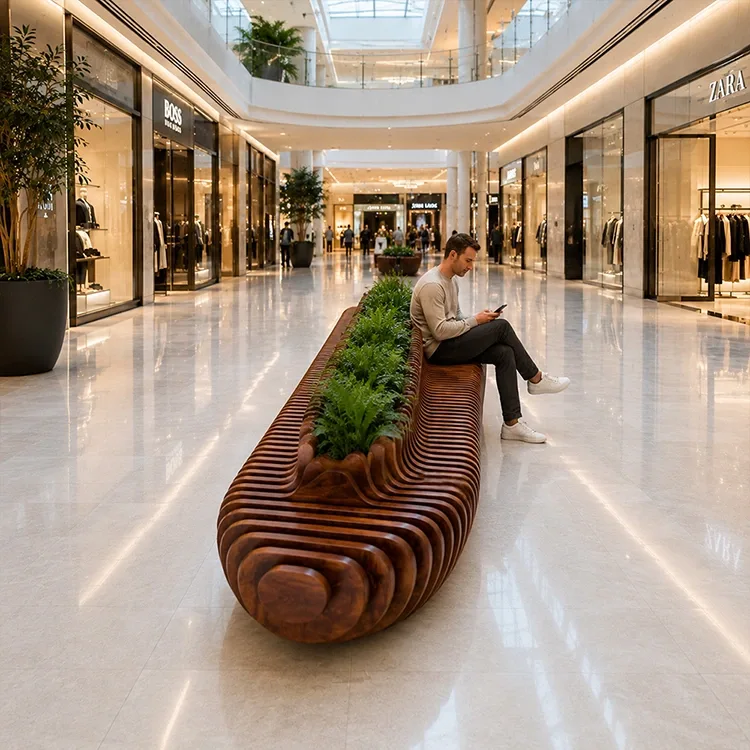
Table of Contents
1. What Is a Parametric Planter Seating Bench?
2. Why Combine Planters and Seating?
3. Essential Design Principles
4. Choosing Suitable Materials
5. Where Can These Benches Be Used?
6. Comparing Different Seating Solutions
7. Customization and Manufacturing Considerations
8. What Should Buyers Check Before Ordering?
1. What Is a Parametric Planter Seating Bench?
A Parametric Planter Seating Bench is a furniture installation that combines a seating structure with one or more integrated planters. Its form is developed through parametric design, a digital approach in which dimensions, curves, spacing, and proportions can be adjusted through defined design parameters.
Unlike conventional benches positioned beside separate flowerpots, an integrated design creates a more unified relationship between furniture and landscaping. The planter may sit at one end of the bench, occupy its center, follow a curved seating arrangement, or form part of a larger modular installation.
Parametric modeling also makes it possible to explore flowing outlines, repeated ribs, layered surfaces, and asymmetrical geometries. These features allow designers to develop furniture that responds to the architectural character of a particular project rather than relying on standard rectangular forms.
For example, a hotel courtyard may benefit from a curved bench surrounding a central planter, while a shopping center may require several connected seating modules with planting zones distributed along the structure. Both concepts can be developed around the same general design principle while serving different spatial requirements.
Explore Chinor's parametric furniture solutions to understand how customized digital forms can be translated into practical furniture for commercial and residential environments.
2. Why Combine Planters and Seating?
Integrating seating and greenery offers practical benefits beyond visual appeal. When these elements are planned together, they can improve space utilization, establish natural gathering points, and create a consistent design language across an outdoor or indoor environment.
Make Better Use of Available Space
In compact courtyards, rooftop gardens, and commercial terraces, separate benches and planters may consume valuable floor space. Combining them can reduce visual clutter and create a more organized layout. Designers can position planting areas along the seating perimeter while preserving clear circulation routes.
Strengthen Biophilic Design
Plants introduce natural color, texture, and seasonal variation into built environments. Placing them directly beside seating encourages people to spend time near greenery, supporting a more welcoming atmosphere in hospitality, workplace, and residential settings.
Create a Recognizable Design Feature
Parametric geometry can turn an ordinary functional object into a focal point. Repeated curves and flowing contours establish visual rhythm, while the plants soften the overall composition. This combination can reinforce a property's identity without relying exclusively on decorative sculptures or oversized landscape installations.
Support Flexible Layouts
Custom dimensions and modular configurations allow the furniture to respond to site conditions. Depending on the design, a bench may be straight, curved, circular, or arranged in multiple connected sections. Planter positions can also be coordinated with entrances, walkways, and views.
- Space efficiency: Integrates two landscape functions into one coordinated installation.
- Visual consistency: Connects planting, furniture, and architecture through a shared design language.
- Customization: Supports project-specific sizes, profiles, finishes, and configurations.
- Social value: Creates comfortable places for resting, informal conversation, and waiting.
3. Essential Design Principles
A successful design must balance visual expression with everyday usability. The following considerations should be addressed before a custom model moves into production.
Seating Ergonomics
Seat height, depth, edge treatment, and back support influence how comfortable the bench feels. A decorative curve should not create awkward seating positions or unnecessarily sharp transitions. For installations intended for extended use, designers should evaluate whether a backrest, arm support, or varied seating orientation is appropriate.
Planter Capacity and Drainage
The planter must accommodate the intended plants, growing medium, and root requirements. Drainage openings, waterproofing, and access for maintenance should be incorporated into the design. Where water could affect nearby seating components, suitable separation and drainage routing are especially important.
Structural Stability
Integrated furniture must support occupants while accommodating the weight of the planter, wet growing medium, and mature vegetation. Large installations may require internal reinforcement, stronger support points, or modular construction. Load calculations should reflect the actual dimensions, materials, and intended use rather than relying on appearance alone.
Proportion and Circulation
A planter that is too large can dominate the seating area, while a narrow seat may feel uncomfortable in a public setting. Designers should evaluate the overall footprint, the relationship between planting and seating, and the space needed for people to approach and move around the installation.
4. Choosing Suitable Materials
Material selection affects appearance, weight, durability, maintenance, and installation cost. The appropriate choice depends on whether the furniture will be used indoors, in a sheltered courtyard, or in an exposed outdoor location.
| Material | Main Advantages | Key Considerations | Potential Applications |
|---|---|---|---|
| Solid wood | Natural grain, warm appearance, tactile comfort | Requires suitable moisture protection and periodic maintenance | Hotels, gardens, residential courtyards |
| FRP or fiberglass | Flexible shapes, relatively low weight, varied finishes | Performance depends on resin, reinforcement, coating, and fabrication quality | Commercial landscapes, resorts, public interiors |
| Metal | High structural strength and a contemporary appearance | Corrosion protection and surface temperature require attention outdoors | Urban plazas, modern commercial spaces |
| Concrete | Substantial appearance and high mass | Heavy transportation, installation requirements, and surface maintenance | Permanent landscape installations |
| Composite construction | Can combine different materials to balance appearance and performance | Interfaces, fasteners, drainage, and differential movement need careful design | Customized commercial projects |
For projects involving complex curves or sculptural planter forms, fiberglass-reinforced plastic (FRP) can offer considerable design flexibility. Solid wood is attractive when natural grain and warmth are priorities, while metal may be appropriate when a project calls for a more industrial aesthetic or a specific structural solution.
Chinor Furniture provides customized furniture solutions using materials and fabrication approaches suited to different project requirements. Buyers should confirm the proposed material, finish, reinforcement, and environmental suitability for each specific design rather than assuming that every configuration has identical performance.
5. Where Can These Benches Be Used?
The versatility of a Parametric Planter Seating Bench makes it suitable for a range of architectural and landscape projects.
Hotels and Resorts
Hotel courtyards, poolside gardens, entrance plazas, and outdoor lounges benefit from furniture that looks distinctive while remaining functional. Integrated planting can soften hard architectural surfaces and establish comfortable places for guests to pause.
Shopping Centers and Commercial Plazas
Retail developments often need seating that supports visitors without obstructing pedestrian movement. Curved installations can help define gathering areas, while repeated modules create a consistent visual identity across large spaces.
Residential Developments
Apartment courtyards, luxury villas, rooftop gardens, and shared residential terraces can use integrated benches to make outdoor areas feel more complete. Custom sizing helps designers coordinate the furniture with pathways, walls, and existing planting schemes.
Offices and Institutional Spaces
Workplace courtyards, campus walkways, and landscaped entrance areas can benefit from informal seating surrounded by greenery. For high-traffic locations, designers should pay particular attention to stability, cleaning access, and the durability of exposed surfaces.
Indoor Atriums
Shopping malls, exhibition spaces, and hotel lobbies can incorporate planter benches as architectural features. Indoor applications still require suitable waterproofing and drainage management to protect flooring and adjacent materials.
6. Comparing Different Seating Solutions
Choosing between an integrated planter bench and conventional outdoor furniture depends on the project's objectives, available space, maintenance resources, and budget.
| Evaluation Factor | Separate Bench and Planter | Parametric Planter Seating Bench |
|---|---|---|
| Layout | Components can be rearranged independently | Creates a coordinated, integrated arrangement |
| Visual character | Often relies on the appearance of individual products | Can provide a unified sculptural focal point |
| Customization | Depends on the dimensions of available products | Can be designed around project-specific geometry |
| Maintenance access | Components are generally easier to separate | Requires planned access to planter interiors and drainage |
| Installation | May involve positioning several separate items | May require coordinated assembly, anchoring, or lifting |
| Best fit | Flexible layouts and frequently changing arrangements | Projects prioritizing integrated design and a distinctive identity |
Neither option is universally better. A separate arrangement may be preferable when frequent relocation is essential. An integrated solution is worth considering when the furniture needs to function as part of a larger architectural composition.
7. Customization and Manufacturing Considerations
Custom parametric furniture requires close coordination between design intent and manufacturing feasibility. A visually attractive rendering is only the starting point; the finished product must also be stable, maintainable, and suitable for delivery and installation.
From Digital Model to Finished Furniture
- Define project requirements. Confirm the installation location, available footprint, intended users, planting scheme, and expected traffic.
- Develop the geometry. Establish seat dimensions, curve profiles, planter locations, and the overall visual rhythm.
- Review materials and structure. Select suitable materials, reinforcement, coatings, and connections for the intended environment.
- Check drainage and maintenance. Plan water outlets, liner access, planting access, and cleaning procedures.
- Validate the design. Review drawings, dimensions, load requirements, and assembly details before production.
- Inspect and prepare for delivery. Check surface quality, dimensions, structural components, and protective packaging.
Chinor's parametric furniture capabilities include digital modeling and CNC-based fabrication for customized designs. Depending on the project, buyers can discuss modifications to overall dimensions, surface finishes, geometry, and modular construction.
For architects and contractors, it is useful to prepare drawings or reference images before requesting a quotation. A clear brief helps the manufacturer evaluate fabrication complexity, shipping dimensions, and the most appropriate production approach.
8. What Should Buyers Check Before Ordering?
Before purchasing a custom seating installation, commercial buyers should review the complete specification rather than focusing exclusively on the initial appearance or quoted price.
- Dimensions: Confirm overall length, width, height, seat height, and planter volume.
- Material specifications: Request details about the structural material, reinforcement, and surface finish.
- Load requirements: Verify that the design is suitable for the expected number of users and installation conditions.
- Outdoor performance: Confirm UV resistance, moisture protection, corrosion resistance where relevant, and temperature suitability.
- Drainage design: Check how excess water is discharged and how the planter is accessed for maintenance.
- Installation method: Establish whether the product is delivered in one piece or in modules and whether anchoring is required.
- Shipping protection: Ask how corners, finishes, and projecting elements are protected during transportation.
- Project documentation: Request dimensioned drawings, finish samples, and installation guidance where appropriate.
- Commercial terms: Confirm lead time, customization costs, minimum order requirements, warranty terms, and delivery arrangements.
For larger projects, a prototype or sample review may help stakeholders evaluate color, tactile quality, proportions, and the relationship between the planter and the seating surface before approving a full order.
9. Frequently Asked Questions
1. What makes a Parametric Planter Seating Bench different from a regular bench?
It combines seating and planting into one coordinated design and uses adjustable digital geometry to create customized curves, proportions, or repeated patterns. The result can serve as both functional furniture and a landscape design feature.
2. Can a planter bench be customized for a specific project?
Yes. Depending on the manufacturer's capabilities, customization may include overall dimensions, seat configuration, planter placement, curve profiles, materials, colors, and finishes. Buyers should provide project drawings or reference images to establish the required specifications.
3. Which materials are suitable for outdoor planter benches?
Solid wood with appropriate protective treatment, outdoor-suitable FRP, corrosion-protected metal, concrete, and engineered composite constructions may all be appropriate. The final choice should reflect local weather, expected traffic, maintenance requirements, and structural needs.
4. How do you prevent planter water from damaging the seating structure?
A suitable design may incorporate waterproof liners, drainage outlets, separation between wet soil and structural components, and protective surface treatments. The drainage route should be planned to avoid water pooling on the seat, damaging nearby flooring, or creating slip hazards.
5. Is this type of furniture suitable for hotels and shopping malls?
Yes. It can be designed for hotel courtyards, commercial plazas, atriums, and other shared spaces. The manufacturer should confirm structural capacity, finish durability, maintenance access, and any applicable accessibility or public-use requirements for the specific project.
6. What information should I provide when requesting a quotation?
Provide the intended application, preferred dimensions, material and finish preferences, estimated quantity, installation location, delivery destination, and any drawings or reference images. These details help the supplier assess feasibility and prepare a more accurate quotation.
10. Conclusion
A Parametric Planter Seating Bench offers a practical way to bring furniture, planting, and architectural expression together. With thoughtful attention to ergonomics, material performance, structural stability, drainage, and installation, it can become a valuable feature in hospitality projects, commercial developments, residential landscapes, and contemporary public spaces.
For project owners, landscape architects, and furniture buyers seeking customized solutions, Chinor Furniture provides parametric furniture design and manufacturing capabilities tailored to different spatial and aesthetic requirements. Explore the company's parametric furniture collection to learn more about custom design possibilities. If you are planning a new landscape installation or developing a commercial furniture specification, contact us to discuss your dimensions, design references, material preferences, and project requirements. Our team can help you evaluate a suitable configuration and move from an initial concept toward a practical, project-ready solution.
Send Inquiry
-
WhatsApp
-
E-mail
-
Wechat