
- English
- Español
- Português
- русский
- Français
- 日本語
- Deutsch
- tiếng Việt
- Italiano
- Nederlands
- ภาษาไทย
- Polski
- 한국어
- Svenska
- magyar
- Malay
- বাংলা ভাষার
- Dansk
- Suomi
- हिन्दी
- Pilipino
- Türkçe
- Gaeilge
- العربية
- Indonesia
- Norsk
- تمل
- český
- ελληνικά
- український
- Javanese
- فارسی
- தமிழ்
- తెలుగు
- नेपाली
- Burmese
- български
- ລາວ
- Latine
- Қазақша
- Euskal
- Azərbaycan
- Slovenský jazyk
- Македонски
- Lietuvos
- Eesti Keel
- Română
- Slovenski
- मराठी
- Srpski језик

How Does 3D Design Become an FRP Product?
How Does a 3D Model Become a Finished FRP Product?
At Chinor, we manufacture custom FRP furniture and decorative products in Huizhou, Guangdong, China. With more than 20 years of FRP production experience, we have worked on everything from practical tables and benches to complex sculptural forms.
When a customer sends us a 3D model or rendering, we do not simply copy the shape and start production. First, we need to understand whether the design can be molded, how it should be divided into sections, and what is required to achieve the intended surface finish.
The FRP manufacturing process involves several connected stages. Understanding them helps designers and buyers communicate more effectively with a factory.
1. Why Does Design Review Come First?
A 3D model can look perfect on a screen but still present manufacturing challenges.
Deep recesses, sharp internal corners, narrow openings and undercuts may make mold construction or demolding more difficult. Large furniture pieces may also require section planning to accommodate production, transportation and installation.
We therefore begin by reviewing the design, dimensions, intended use and surface requirements. For a bench, for example, we need to understand not only its appearance but also how it will be supported and used.
A 3D file is useful, but dimensioned drawings, reference images and functional requirements are also valuable. If adjustments are necessary, identifying them before mold making is generally more efficient than changing the design after production has started.
2. How Is an FRP Mold Made?
Once the design and production approach have been reviewed, mold development can begin.
For suitable designs, CNC machining can shape the mold according to the approved digital model. The choice of mold material and construction depends on the product's size, geometry, surface requirements and production quantity.
The mold establishes the basic form of the finished product. Its accuracy influences dimensions and contours, while the quality of its surface preparation affects the appearance of the molded part.
Not every project requires exactly the same mold-making method. A simple product and a large sculptural bench may involve very different considerations.
This is why we recommend discussing mold development together with the product design, rather than treating it as an isolated production step.
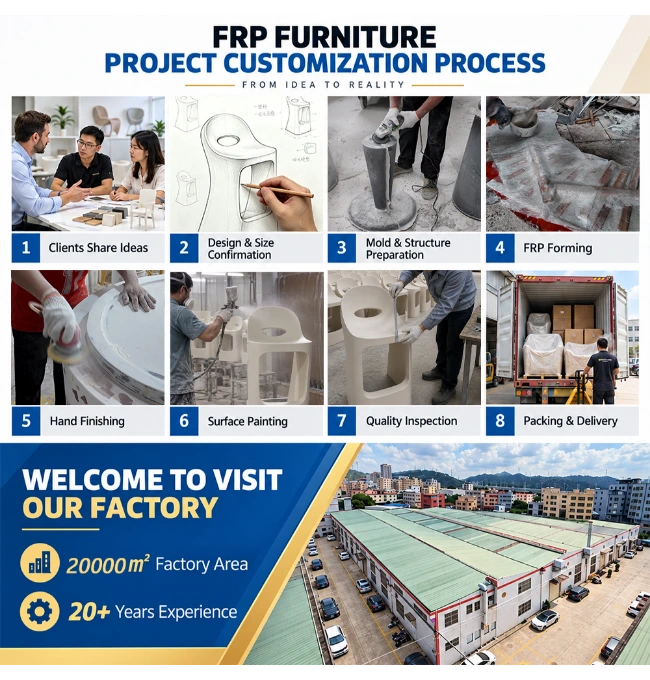
3. What Happens During FRP Hand Lay-Up?
After the mold has been prepared, the production team can begin the molding process.
In FRP hand lay-up, glass fiber reinforcement is placed into the mold and combined with resin. The laminate is built up according to the product's design and performance requirements.
This stage requires careful attention to fiber placement, material coverage, corners and areas that may need additional reinforcement. Complex curves can require particular care to ensure the reinforcement follows the intended shape.
The construction should match the product's purpose. A decorative sculpture, an outdoor planter and a bench designed for regular use do not automatically require the same laminate specification.
4. Why Are Demolding and Sanding Important?
Once the material has cured sufficiently, the molded part can be released from the mold.
The team then trims excess material, refines edges and sands the surface where necessary. Depending on the product, additional surface correction may be required before painting.
This stage has a direct influence on the final appearance. Even when the original mold is accurate, visible edges, surface irregularities or small imperfections may still need attention.
For products with smooth curves and high-gloss finishes, preparation is particularly important. The quality of the finished surface depends on more than the initial molding operation.
5. How Are Color and Surface Finish Applied?
After surface preparation, the product moves to the specified finishing stage. Depending on the design, this may involve primer, paint, color matching and a suitable protective coating.
Customers can provide RAL color codes, reference photos or physical samples to clarify their requirements. For projects with strict color or gloss expectations, agreeing on a finish sample before bulk production can help establish a clear reference.
Outdoor products may require a different coating specification from indoor furniture, depending on the installation environment and expected exposure.
6. How Is the Finished Product Checked?
Before shipment, the product should be checked against the agreed specifications. Relevant checks may include dimensions, surface quality, color, edges and assembly details.
Packaging should also be considered, especially for oversized furniture and sculptural products. The shape, vulnerable areas and shipping method influence how the product should be protected.
From our experience, clear communication at the beginning makes the later stages easier. Confirming drawings, finish expectations and packaging requirements before production helps avoid unnecessary revisions.
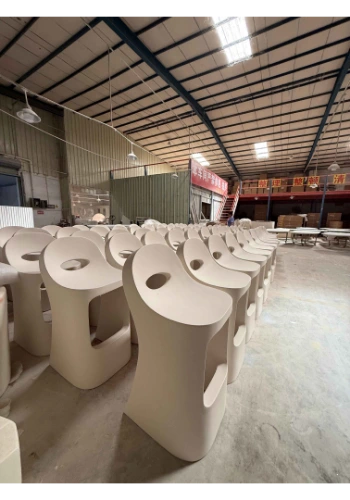
What Should You Prepare Before Contacting a Factory?
You do not always need a finished 3D model to start a project. A sketch, reference image or initial concept can be enough for an initial discussion.
The more information available about dimensions, intended use, finish and order quantity, the easier it becomes to assess the manufacturing approach.
At Chinor, we review custom concepts with these practical considerations in mind. If you have a design that needs to be brought to life, we can discuss the next steps toward developing a custom FRP product.
Send Inquiry
-
WhatsApp
-
E-mail
-
Wechat